
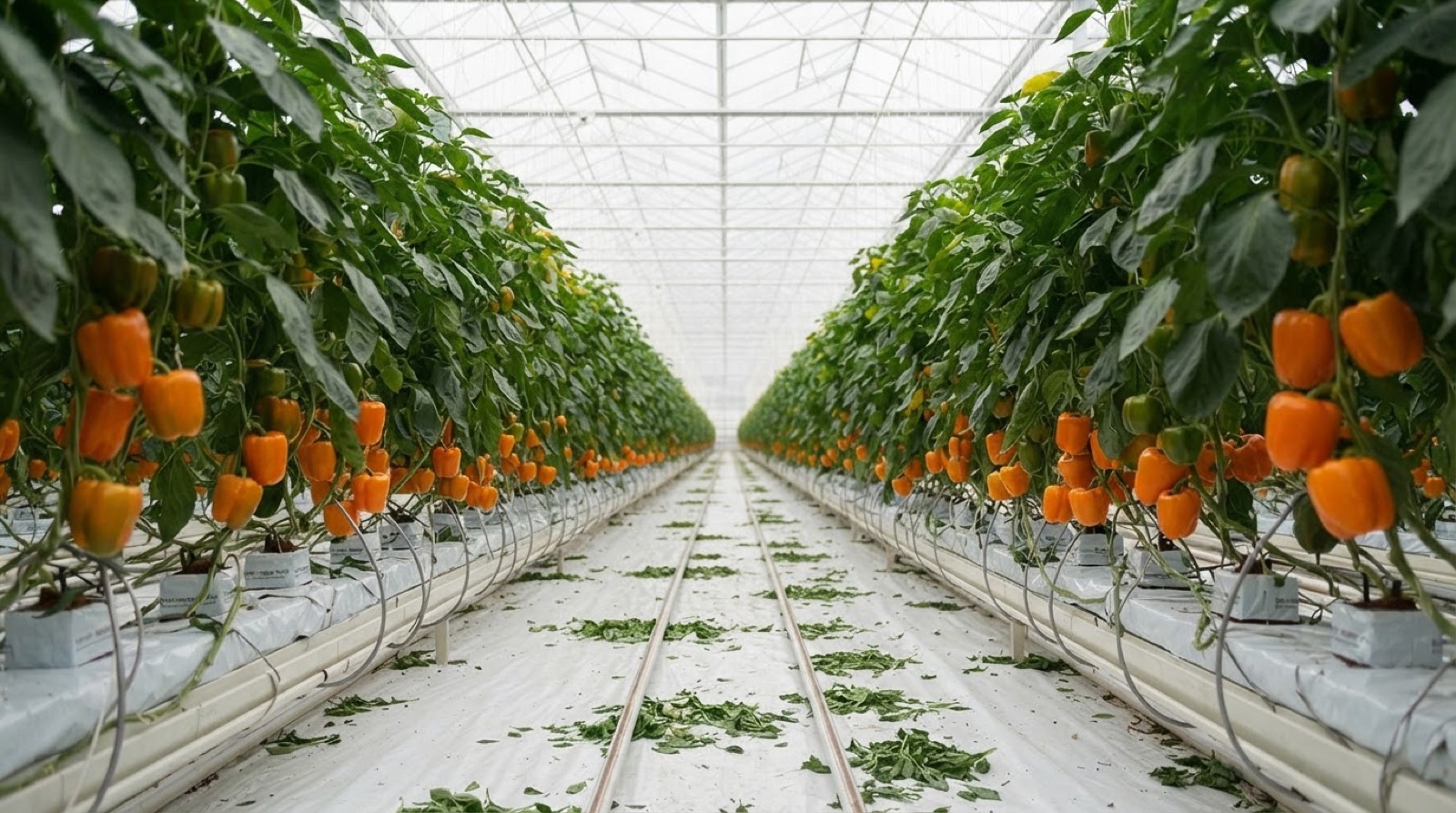
Sweet pepper
Orange Bell Peppers.
Une classe génotypique distincte, et non une nuance de rouge.
La maturité est tout l’enjeu
Le poivron carré orange est conduit jusqu’à pleine maturité, et c’est là que se trouve la valeur gustative d’un poivron. La vitamine C, le sucre et les pigments caroténoïdes se constituent pendant les semaines qui suivent l’arrêt de la croissance du fruit. Un poivron qui ne termine jamais sa coloration ne termine pas non plus de les constituer.
L’orange s’achète avec l’œil. Il se vend en emballages mélangés, où la couleur est l’argument et où l’acheteur suppose que tous les fruits de la barquette sont dans le même état. Rendre cela vrai est un problème de calendrier plutôt que de climat : chaque couleur mûrit selon son propre rythme, et un emballage ne vaut que ce que vaut le fruit le plus vieux qu’il contient.
C’est la distance qui met cette hypothèse en défaut. Un fruit cueilli mûr n’a plus de développement à dépenser : une chaîne longue se traduit par du ramollissement et des rides plutôt que par un défaut de couleur. Une serre proche de son marché coupe chaque couleur au fur et à mesure du remplissage de l’emballage, et la barquette arrive en rayon avec des fruits d’un seul âge au lieu de plusieurs.
Valeurs nutritionnelles
Poivron, rouge, cru
Pour 100 g
- Énergie
- 26 kcal
- Matières grasses
- 0.3 g
- Glucides
- 6.03 g
- dont sucres
- 4.2 g
- Fibres
- 2.1 g
- Protéines
- 0.99 g
- Sodium
- 4 mg
- Potassium
- 211 mg
- Vitamine C
- 127.7 mg
Source : USDA FoodData Central, FDC 170108
Le poivron carré orange est une classe génotypique à part entière, avec ses propres cultivars, et non un poivron rouge cueilli à un autre moment. La forme du fruit est la même forme cubique à quatre lobes qui définit la catégorie du poivron carré, et la couleur orange est génétique. Les acheteurs traitent les couleurs comme des produits distincts, et les emballages multicolores sont assemblés à partir de cultures séparées plutôt que triés au sein d’une seule.
Ce que la culture demande
La plante est à cycle long, sur substrat et sur fil haut, et partage la référence climatique et structurelle du poivron carré. Comme pour tout poivron conduit à couleur, le fruit occupe la plante jusqu’à ce qu’il se colore : la saison se planifie autour du temps de maturation plutôt qu’autour de l’atteinte de la taille finale. C’est un climat stable sur des semaines qui maintient la nouaison continue.
Ce que la serre doit assurer
La classe de couleur change le calendrier que la serre doit tenir, non l’enveloppe qu’elle fournit. Chaque classe mûrit selon son propre calendrier, et une serre qui conduit plusieurs couleurs conduit plusieurs calendriers sous un même climat. Le découpage en compartiments et le plan de conditionnement portent cette contrainte, car un climat ne peut pas être réglé dans deux directions à la fois.
Le reste relève de la construction pour poivron carré. La structure porte une plante à cycle long sur fil haut, la conception du chauffage et des écrans se dimensionne sur la période de coloration plutôt que sur la période de nouaison, et l’irrigation est calibrée pour la pointe. C’est l’uniformité de couleur à l’intérieur de l’emballage que l’acheteur inspecte : l’homogénéité sur toute la surface décide de la part de la culture qui atteint le premier choix.
DutchGreenhouses® définit la structure, le climat, les écrans et l’irrigation autour de la culture de poivron, de sa classe de couleur et du climat local, afin que la maturation tienne le calendrier attendu par le conditionnement. Contactez-nous pour planifier une serre à poivrons.
Le poivron carré orange, questions et réponses
L’orange exige-t-il une serre différente de celle du rouge ?
Non. La structure et l’enveloppe climatique sont communes aux couleurs du poivron carré. Ce qui diffère, c’est le calendrier de maturation, et cela se traduit dans le découpage en compartiments et le plan de conditionnement plutôt que dans la spécification du bâtiment.
Pourquoi cultiver un mélange de couleurs ?
Les emballages mélangés sont un format de vente au détail, assemblé à partir de cultures séparées. Chaque couleur est planifiée, cultivée et récoltée comme une culture à part entière.
L’orange mûrit-il au même rythme que le rouge ?
Le temps de maturation est une propriété du cultivar et varie selon la classe. C’est l’une des données qui fixent le plan de récolte, et c’est pourquoi les couleurs sont planifiées comme des cultures séparées plutôt que comme une seule culture cueillie à des stades différents.
Other sweet pepper
varieties.
Couleur, taille et qualité à la récolte. La catégorie que vous vendez détermine la charge de plante, le rythme de récolte et la serre.
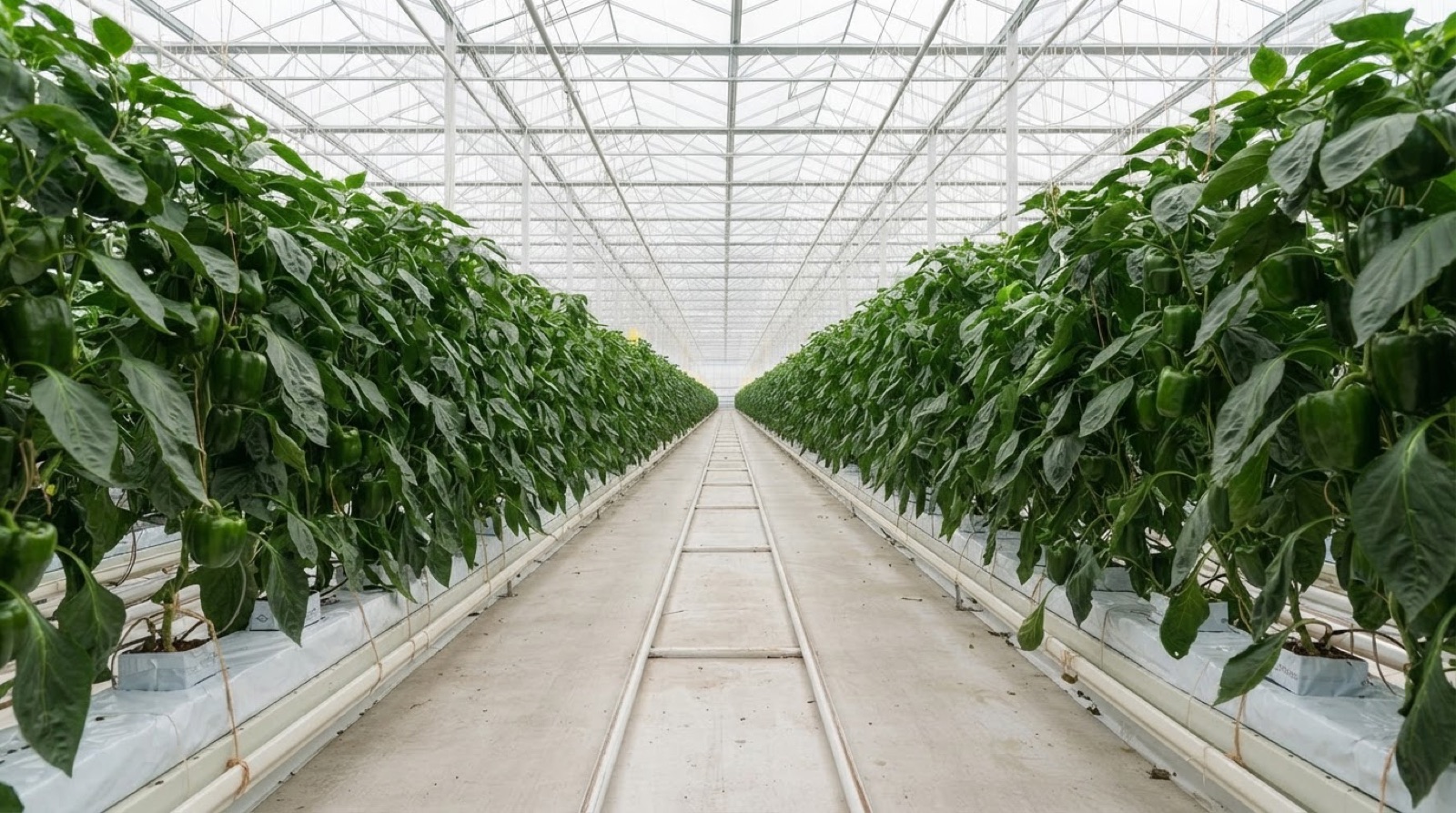
Green Bell Peppers
Green bell pepper is fruit picked before it colours, a harvest stage rather than a colour genotype.
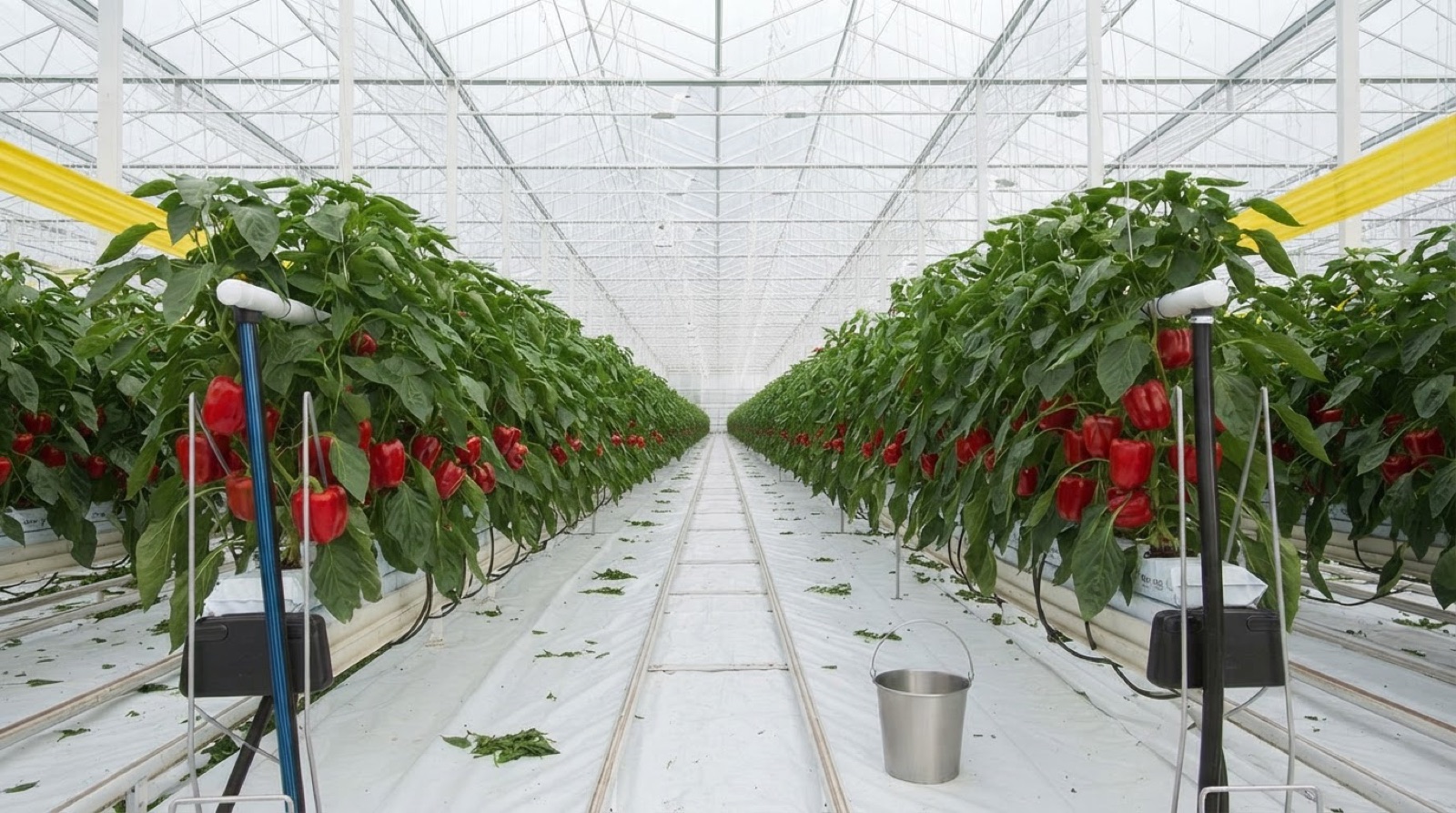
Red Bell Peppers
Red bell pepper is the reference block pepper of Dutch production, carried on the plant until it colours fully.
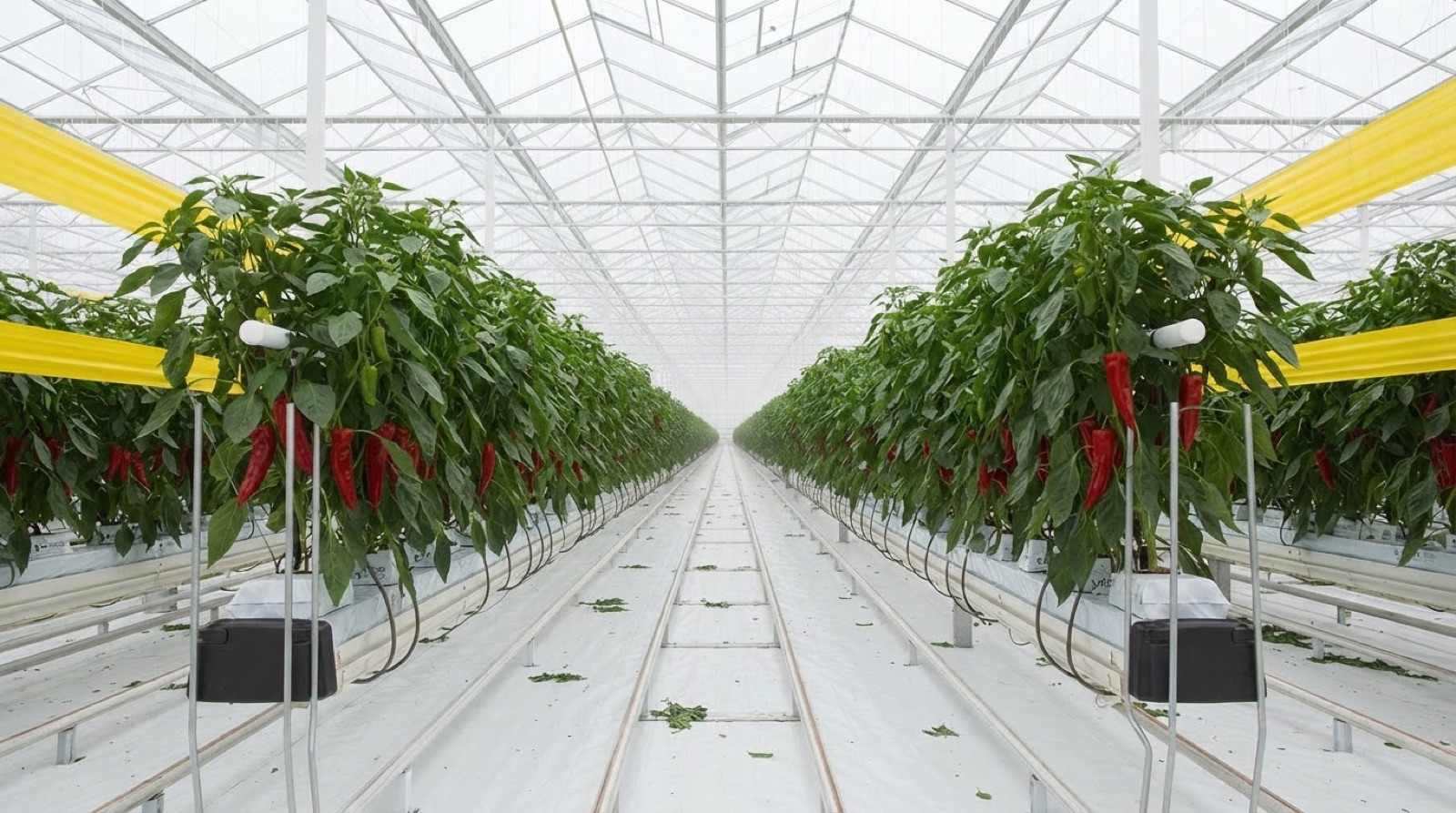
Red Pointed Peppers
Red pointed pepper is a conical, elongated sweet pepper sold for its sweetness and for roasting and grilling.
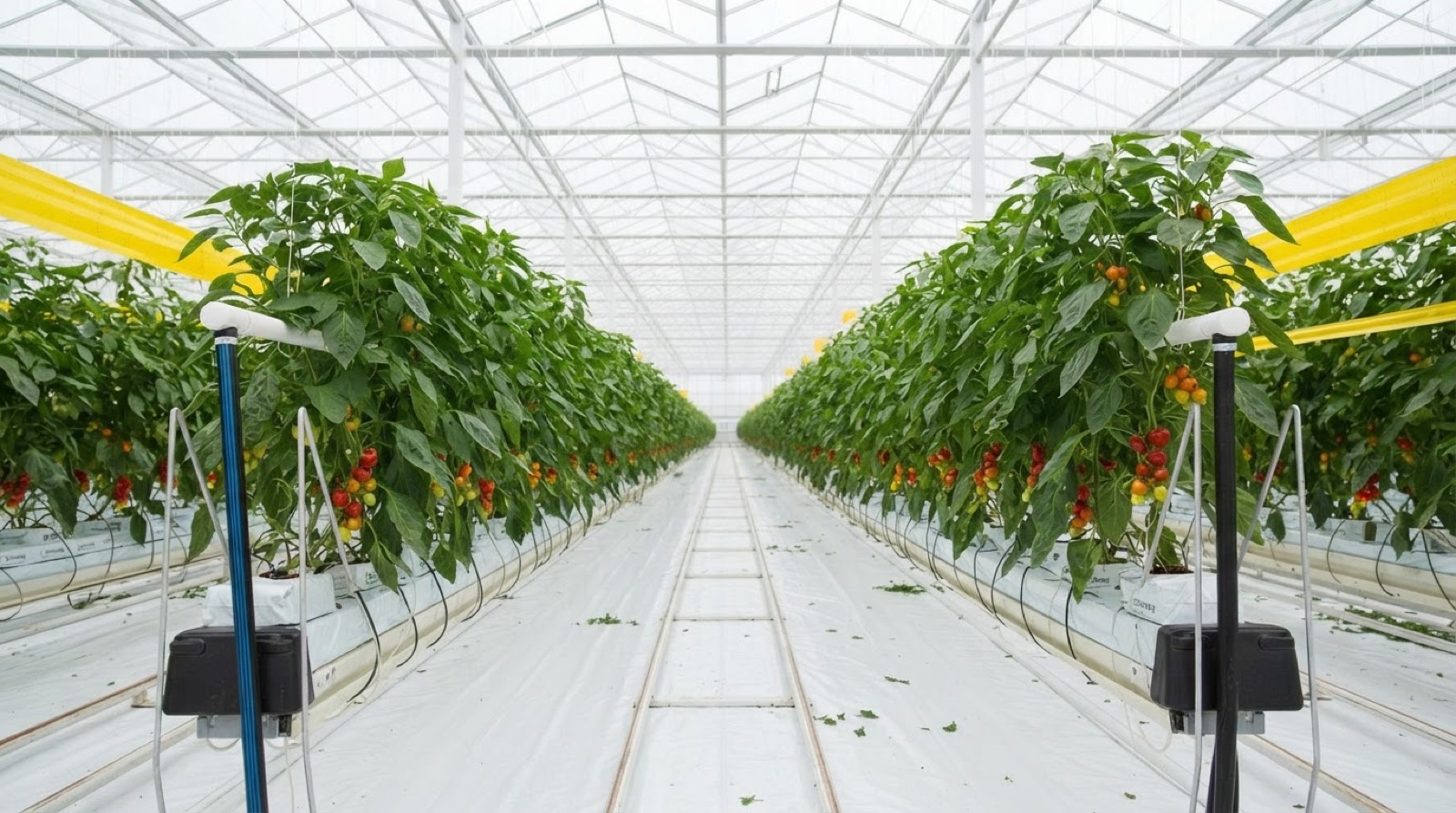
Snack Peppers
Snack pepper is a market and pack idea more than a defined botanical type: small sweet peppers sold in mixed-colour punnets to be eaten whole.
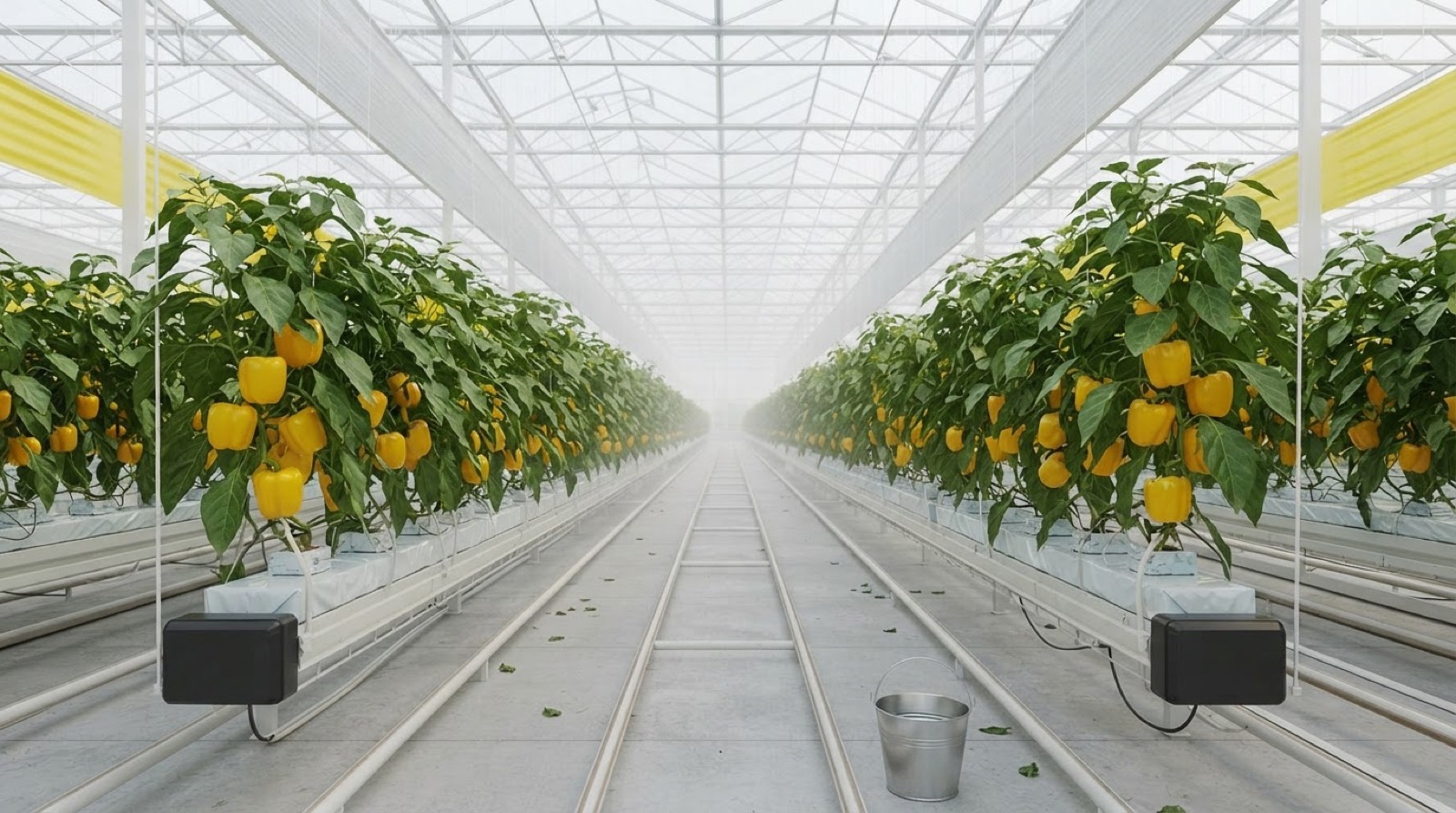
Yellow Bell Peppers
Yellow bell pepper is its own genotype class with its own cultivars, not a red pepper picked at a different moment.
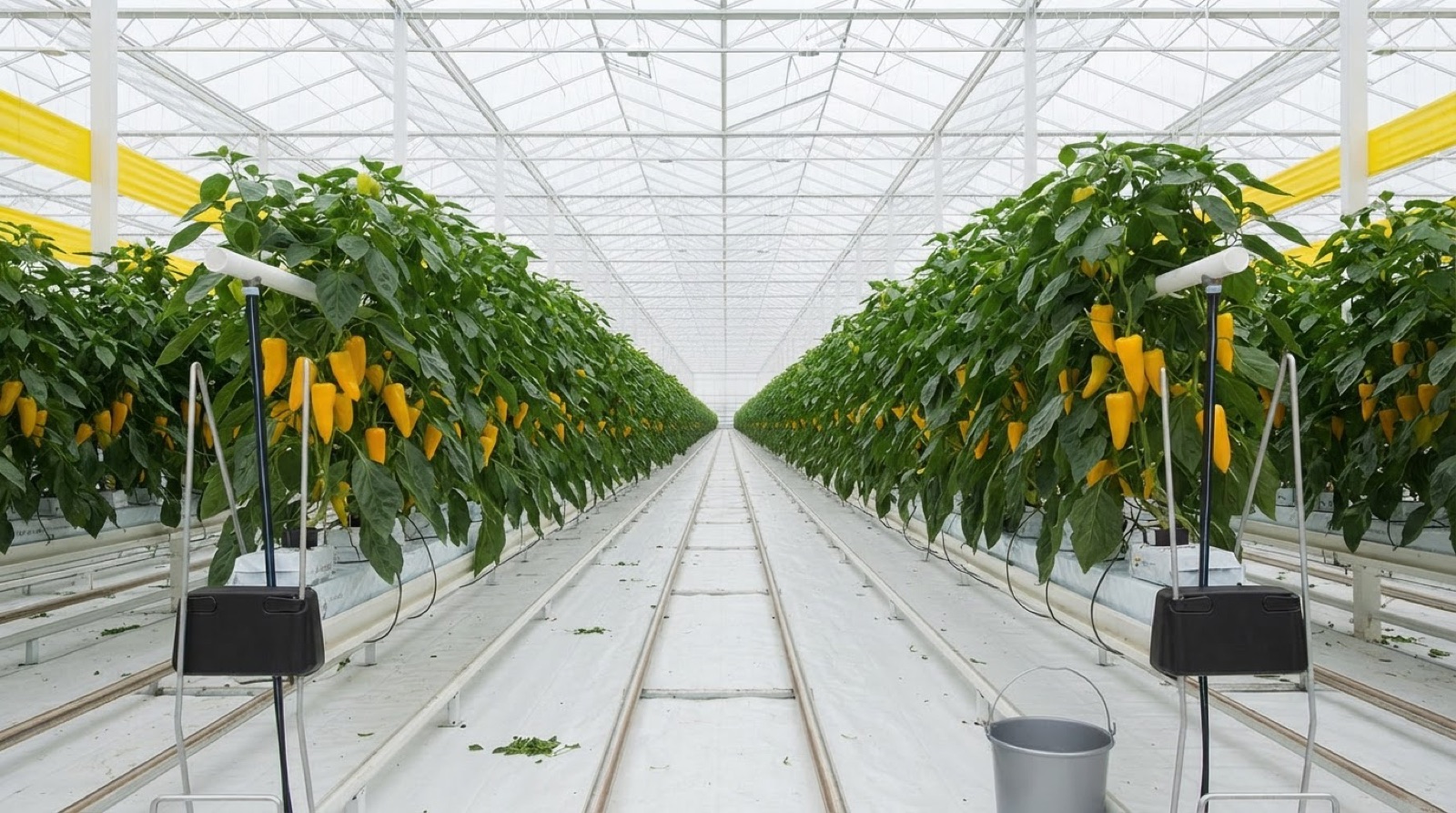
Yellow Pointed Peppers
Yellow pointed pepper is the yellow-ripening conical sweet pepper, distinct from both the yellow block pepper and the red pointed type.
La serre derrière poivrons
Poivrons, sous verre.
Culture palissée sur substrat.
La charge de la plante, la lumière dans le couvert et la gestion du climat soutiennent une culture longue à récoltes répétées.
Couleur, taille et qualité à la récolte.
Culture palissée sur substrat.
Reliez les calibres de couleur et de taille à votre marché et à votre plan de récolte.
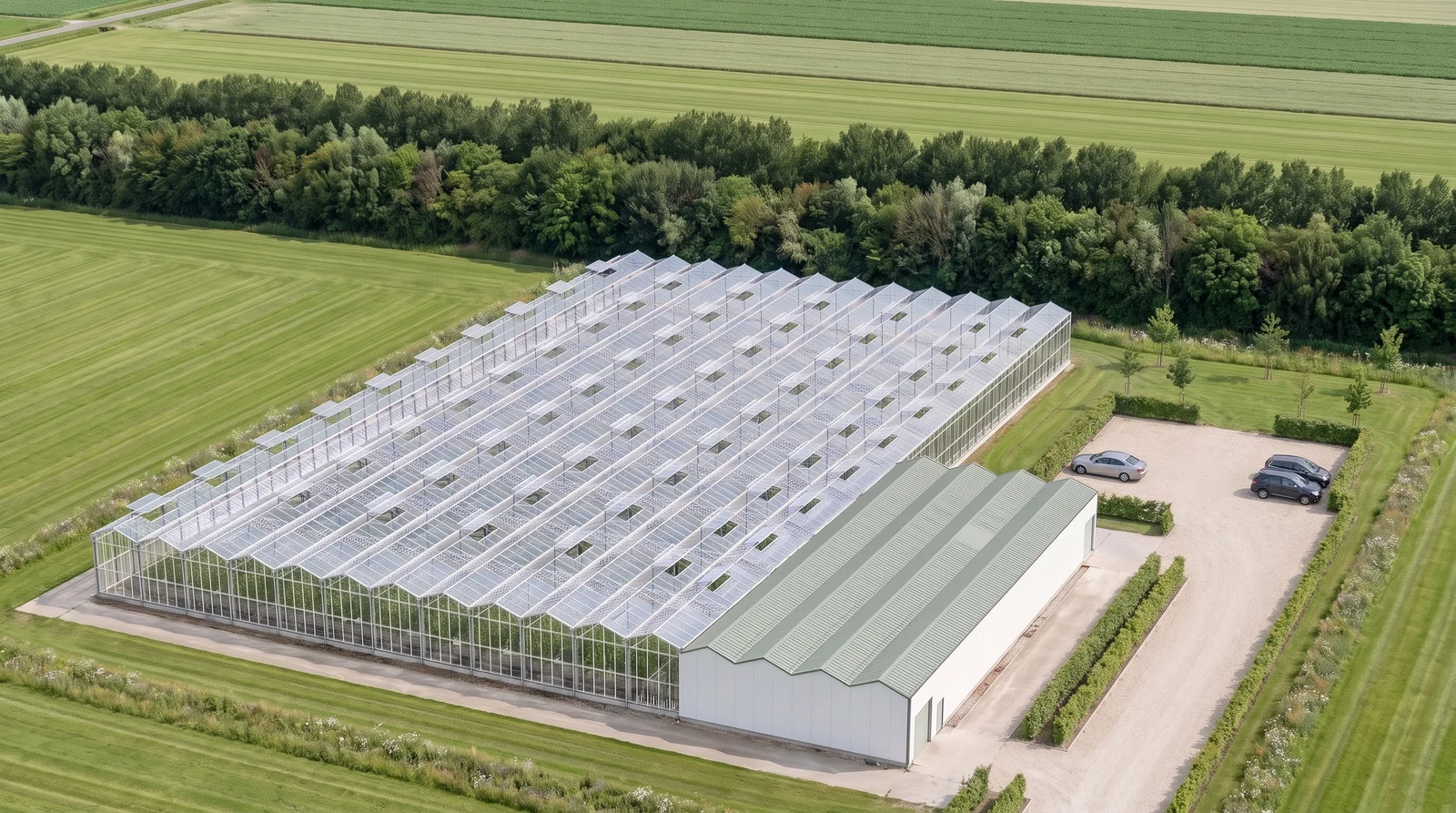
Expert Hydroponic Greenhouse Series
Une structure définie pour l’hydroponie de production. La culture détermine le système de culture, la stratégie climatique et l’organisation de la récolte.
½ acre1 acre2 acresExplorer Expert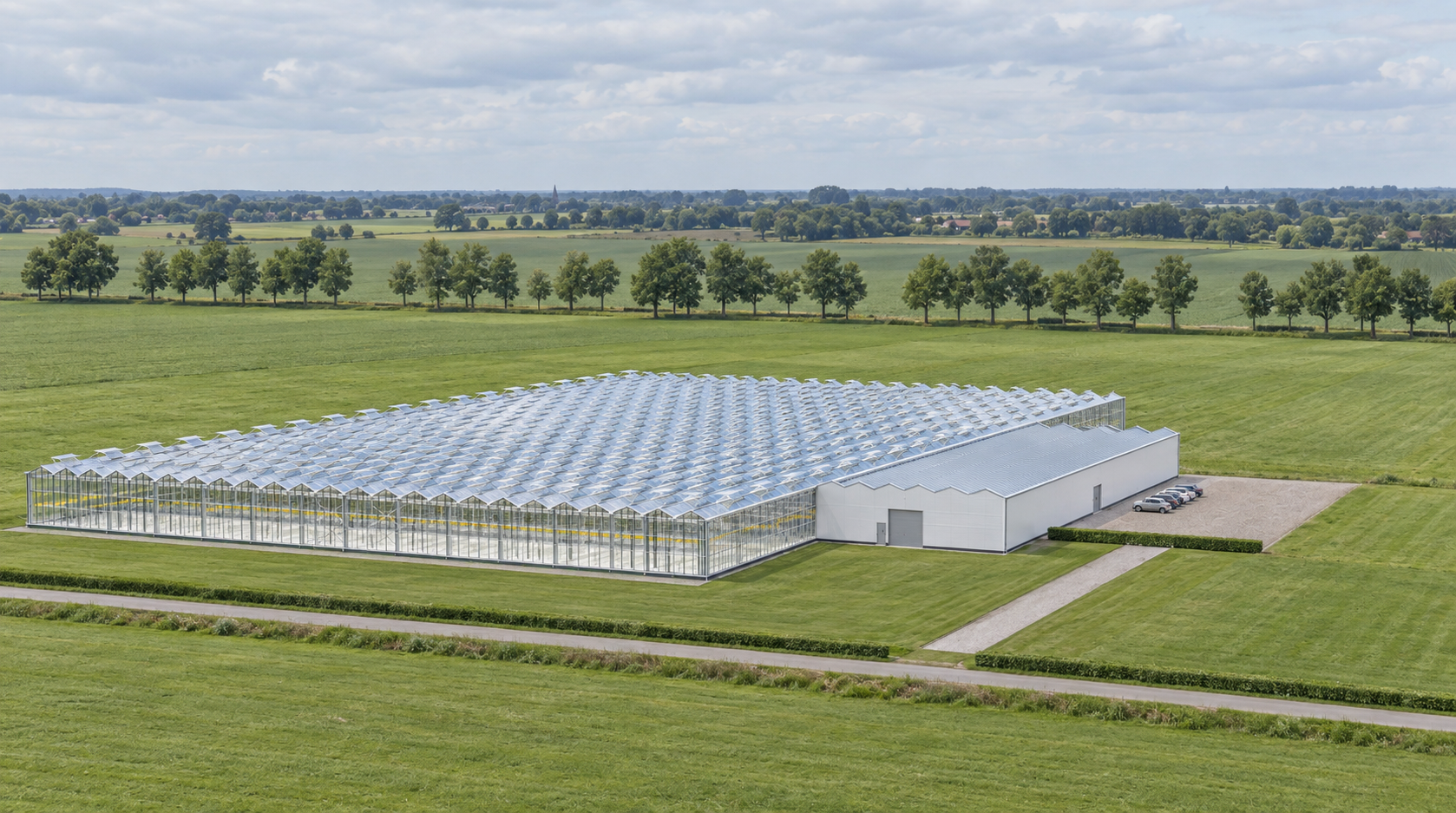
Plus Hydroponic Greenhouse Series
Notre plus grande gamme standard. Adaptez la surface de culture plus importante à la demande de la culture, à la main-d’œuvre, aux réseaux et au marché que vous comptez approvisionner.
2 acres4 acres8 acresExplorer Plus4,032 m²43,400 sq ft de surface de culture, c’est là qu’un plan poivrons commence généralement (GrowPro Expert 1 acre). Comparer les neuf modèles
Mettez votre prochaine récolte
sous verre.
Votre culture, votre site et le volume que vous voulez vendre. Trouvons la serre et les systèmes qui correspondent.
Besoin d’une serre sur mesure ?GrowPro Expert
Nous pouvons aussi planifier une autre culture ou un programme de cultures mixtes.
Parler de votre projet Continuez vers notre formulaire de contact. Sans engagement.Des lectures qui pourraient vous intéresser

Grow Like a Pro: Starting Smart, Growing Strong
How Grow Like a Pro combines smart farming, CEA technology and local partnerships for eco-friendly, profitable, pesticide-free greenhouse pr
Lire l’article
Maryland Cannabis Greenhouse: Year One
One year on: how the Maryland cannabis greenhouse, paired with an adjacent indoor facility, cut the energy bill and lifted both yields and q
Lire l’article
The Case for a College Greenhouse
Why a college greenhouse belongs in the curriculum: teaching science, craftsmanship, business logic and sustainability, and preparing studen
Lire l’article
The Case for a High School Greenhouse
Why every high school greenhouse matters: how it makes STEM tangible, builds responsibility and teamwork, and helps students discover their
Lire l’article
Greenhouses in Education: The Case for Schools
Greenhouses in education reconnect students to reality — the full case for why every school, high school, college and trade program should h
Lire l’article
The Origins of Greenhouse Horticulture: My Backyard
A tour through greenhouse horticulture history: from 19th-century Westland fruit walls to the “City of Glass” and today’s international high
Lire l’article